
Reconstitution Guide
Reconstitution & Injection Guide
Every protocol on this site rests on the same three numbers: how much peptide is in the vial (mg), how much liquid you add to it (mL), and how many units you draw into the syringe. This page explains how those three connect.
1. What reconstitution is
Peptides ship as a dry, freeze-dried (lyophilized) powder in a sealed vial. To inject them, the powder must be dissolved in a sterile liquid — usually bacteriostatic water (sterile water with 0.9% benzyl alcohol, a preservative that lets a vial be used repeatedly over time).
- Let the vial and the water come to room temperature.
- Remove the plastic cap and wipe the rubber stopper of both vials with an alcohol swab.
- Draw the exact water volume the protocol specifies (for example 2 mL or 3 mL) into a syringe.
- Insert the needle through the stopper and aim the stream at the wall of the vial, not directly onto the powder.
- Swirl gently until fully dissolved. Do not shake — vigorous agitation can damage the peptide.
- Label the vial with the date and the water volume you used.
2. How to read syringe "units"
The standard syringe for these injections is a U-100 insulin syringe, where:
100 units = 1 mL50 units = 0.5 mL10 units = 0.1 mL
The key point: units measure volume, not amount of peptide. The same 10 units hold a completely different amount of peptide depending on how much water you added — which is why the mix volume in each protocol has to be followed exactly.
3. The math
concentration (mg/mL) = mg in vial ÷ mL of watermg per unit = concentration ÷ 100units per dose = target dose (mg) ÷ mg per unit
For example, a 20 mg vial mixed with 2 mL gives a concentration of 10 mg/mL, so each unit holds 0.1 mg — meaning 10 units is exactly 1 mg. Mix that same vial with only 1 mL and those same 10 units now hold 2 mg, double the dose.
The dose calculator works out any vial-and-water combination for you.
4. Storage
- Dry powder (before mixing): cool, dry and dark. For long-term storage, the freezer.
- After reconstitution: refrigerated at 2–8°C. Do not freeze once mixed.
- Keep the vial away from direct light and heat, and avoid repeated freeze-thaw cycles.
- If the solution turns cloudy, changes color, or shows particles, do not use it.
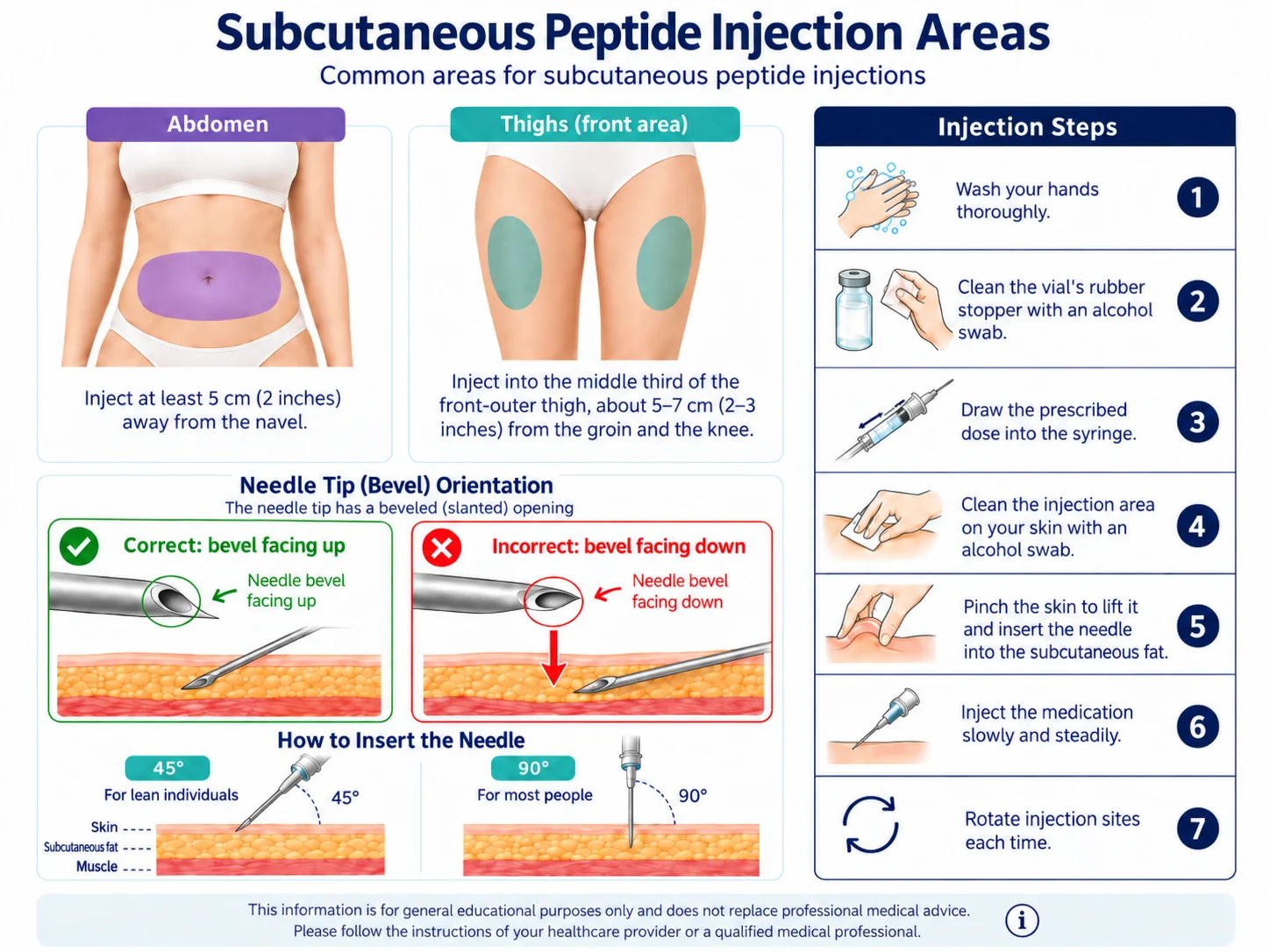
5. Subcutaneous injection technique
Most protocols here are subcutaneous (sub-Q) — into the fat layer beneath the skin, not into muscle.
- Common sites: the abdomen (about 5 cm away from the navel), the outer thigh, the back of the arm.
- Rotate sites every time to avoid local irritation and tissue build-up.
- Clean the skin with an alcohol swab and let it dry.
- Pinch the skin gently and insert the needle at 45–90 degrees.
- Inject slowly, withdraw, and apply light pressure.
- Single-use needles only — never reuse or share a needle. Dispose of it in a sharps container.
6. Safety notes
- Most compounds described on this site are not approved medicines for human use, and many are sold for research purposes only.
- This information documents commonly used protocols; it is not a personal recommendation. An appropriate dose depends on medical history, other medications, and individual factors.
- Consult a qualified physician before any use — particularly during pregnancy or breastfeeding, with chronic conditions, or while taking regular medication.
- Stop immediately and seek medical care for any unusual reaction: shortness of breath, swelling, widespread rash, or dizziness.